Leh Women’s Protest Against Liquor Shops Enters Day Six as Sonam Wangchuk Targets Ladakh Administration
By: News Desk | 26 October 2026
Leh: A growing protest against the expansion of liquor outlets in Ladakh has brought questions about public health, cultural traditions and community participation into sharp focus, with women from different religious communities continuing their sit-in in Leh and climate activist Sonam Wangchuk accusing the Union Territory administration of encouraging alcohol availability despite public opposition.
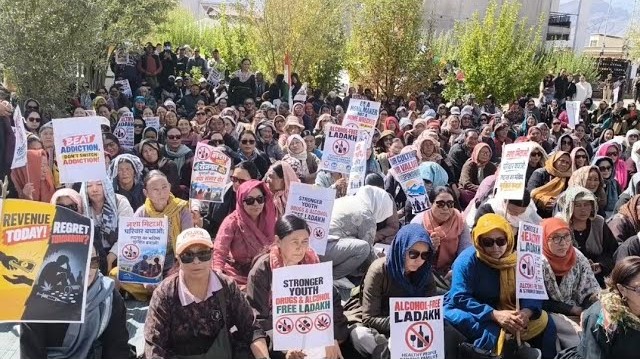
The agitation, centred at Nawang Dorjay Stobdan (NDS) Memorial Park in Leh, had entered its sixth day by October 26, according to reports. Women are demanding the closure of newly opened liquor outlets and a review of the policy that has allowed additional licences for bars and other establishments selling alcohol.
The protest has drawn participation from women associated with Buddhist, Muslim and Christian organisations, along with other civil society groups. Participants say the expansion of liquor sales could have consequences for families, young people and the region’s traditional community life.
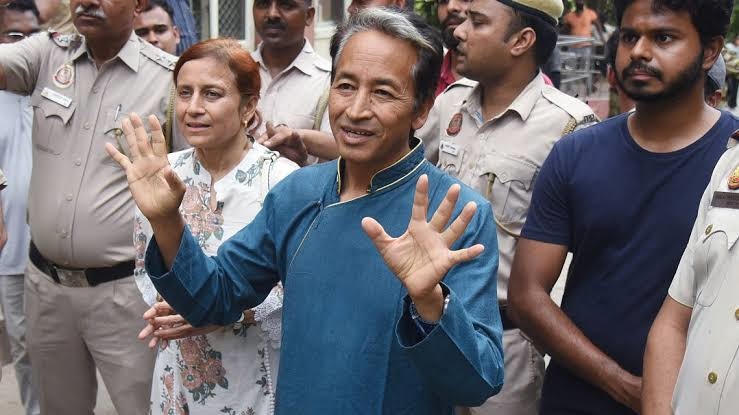
Wangchuk has lent his support to the agitation, using sharp language to criticise Lieutenant Governor Vinai Kumar Saxena and the administration’s approach to alcohol regulation.
In a post on X, Wangchuk described the situation as a dispute on Ladakh’s own “border”, arguing that the region’s conflict was not with China but with its own administration over the spread of alcohol availability. He accused the authorities of “firing alcohol cannons” while claiming to address the drug menace.
He also questioned what he described as a contradiction between promoting alcohol availability in Ladakh and maintaining prohibition in Gujarat. His remarks reflect his wider criticism of administrative decisions that he says are being taken without adequate public consultation.
The controversy has moved beyond the question of individual liquor shops. For the protesters, it has become a debate about how economic and regulatory decisions are made in a region where religious traditions, family welfare and community consent carry considerable social importance.
Women From Different Communities Unite Against Liquor Outlets
One of the most notable features of the agitation is the participation of women from different religious and social organisations.
The women’s wing of the Ladakh Buddhist Association, the Christian Women’s Community in Leh and women associated with Anjuman Moin-ul-Islam have publicly expressed concern about the expansion of liquor outlets. Their participation has given the protest a broader community character rather than limiting it to a single organisation or religious group.
Kunzes Dolma, president of the women’s wing of the Ladakh Buddhist Association, told The Tribune that women from several religious communities had felt compelled to protest following the opening of new liquor shops. She said the demonstrators wanted the outlets closed.
Ruth Pem, president of the Christian Women’s Community in Leh, raised concerns about the potential impact of increased alcohol availability on families and younger people. Salima Khatun, vice-president of the women’s wing of Anjuman Moin-ul-Islam, said protesters had already attempted to communicate their concerns to the authorities, including through a memorandum.
The accounts point to a central grievance: protesters believe the decision to expand alcohol sales should have involved more consultation with the communities that may be affected.
For the women participating in the sit-in, the issue is not simply whether a business has obtained a licence. It is whether the wider social consequences of alcohol availability have been adequately considered before commercial permissions are granted.
Women’s groups have also called for Ladakh to be declared a dry region, meaning a territory where the sale of alcohol is prohibited or substantially restricted. Such a demand would represent a wider policy change, not merely the cancellation of a few licences.
The administration now faces pressure to explain the policy, address the protesters’ concerns and clarify whether any review of the licences or regulatory arrangements is possible.
Protesters Brave the Cold to Maintain Their Sit-In
The agitation has continued despite the cold conditions typical of Leh in late October.
According to The Tribune, large numbers of people have joined the protest during the day, while around 15 to 20 women have generally remained at the site overnight. Groups from different villages have reportedly taken turns to maintain the sit-in.
The sustained presence of women at the protest site has helped keep the issue in public view. Their participation also signals that the concern is not confined to one neighbourhood or a single day of demonstrations.
The protesters say they fear that wider availability of alcohol could increase the risk of addiction, family conflict and other social problems. These are concerns expressed by the demonstrators; the scale of any actual increase in such outcomes would need to be assessed using reliable local data rather than assumed from the number of licences granted.
Alcohol-related harm can affect households through several pathways, including financial strain, health problems, unsafe driving and interpersonal conflict. However, the consequences depend on factors such as patterns of consumption, enforcement, access to treatment and public awareness. Licensing policy is one part of that wider picture.
The women’s demands therefore raise two distinct questions for policymakers: whether the expansion of outlets is appropriate for local conditions, and what safeguards should be in place to reduce alcohol-related harm if sales continue under the existing regulatory framework.
What Is Behind the Dispute Over Ladakh’s Excise Policy?
The immediate dispute concerns the opening of new liquor outlets and the granting of additional bar licences under Ladakh’s excise framework.
Official notifications show that Ladakh’s Excise Policy for 2026–27 was introduced with effect from July 1, 2026. A subsequent adaptation notification dated August 26 provided for the continuation of the previous year’s policy, with specified modifications, for the remaining period covered by that notification.
The excise framework governs the licensing and regulation of alcohol sales, including the applicable categories of licences, eligibility conditions, fees and related procedures. The administration’s Excise Department identifies regulation of liquor and intoxicants, collection of excise revenue and prevention of illicit trade among its responsibilities.
The existence of a licensing framework does not, by itself, resolve the social concerns raised by protesters. A licence may be valid under the applicable rules while the broader policy remains open to public debate over its effects, location criteria and safeguards.
The current agitation centres partly on where outlets or bars are being permitted. Wangchuk and the protesters have referred to concerns about alcohol-related establishments in villages, homestays, guesthouses and near places such as schools and temples. Those claims reflect the protesters’ objections and should be examined against the actual locations and conditions attached to individual licences.
A transparent policy response would clarify how licences were allocated, what restrictions apply to the location and operation of outlets, how compliance is monitored and what procedures exist for residents to raise objections.
Such information could help distinguish between concerns that can be addressed through enforcement of existing rules and those that require a broader review of the excise policy.
The Social Concerns: Youth, Families and Community Life
The protesters’ principal argument is that increased availability of alcohol could create social costs that extend beyond the commercial activity of individual outlets.
Their concerns include possible alcohol misuse among young people, household financial pressure, family disputes, road accidents and a gradual weakening of community practices that discourage drinking.
These concerns deserve a considered public response, but it is important to distinguish potential risks from established outcomes. The opening of additional licensed outlets does not automatically prove that addiction, domestic violence or accidents have increased. Demonstrating such a connection would require credible evidence, including data on alcohol consumption, health impacts, road incidents and other relevant indicators.
At the same time, the absence of immediate evidence of harm does not mean that concerns about prevention should be ignored. Policymakers routinely assess potential risks before they become more difficult or costly to address.
In Ladakh, the debate is especially sensitive because community organisations view alcohol policy through the lens of local traditions, religious values and the pressures associated with social and economic change.
For women participating in the agitation, the consequences of harmful drinking are a household concern. Their argument is that families and communities should have a meaningful opportunity to express their views before the administration adopts policies that may affect them.
A constructive response would combine transparent licensing decisions with public education, enforcement against illegal sales, prevention programmes and accessible support for people experiencing alcohol-related problems.
If the administration believes that the existing policy is necessary or appropriate, publishing the rationale and safeguards would help residents assess that position. If weaknesses are identified, the government could consider changes to licensing conditions, location restrictions or consultation procedures.
Wangchuk’s Criticism Connects the Liquor Dispute to Wider Governance Questions
Wangchuk’s intervention has given the protest greater political visibility.
His criticism extends beyond the specific question of alcohol sales. In recent comments on Ladakh’s governance, he has argued that important decisions affecting land, resources, identity and local institutions require stronger democratic participation and public consent. He has also cited the women’s agitation against liquor outlets as an example of concerns about policies being pursued without sufficient consultation. <Cite refs={[“turn557434search7″,”turn557434search9”]}/>
The liquor-policy controversy is therefore unfolding within a wider discussion about Ladakh’s administration since it became a Union Territory in 2019.
Ladakh does not have an elected Legislative Assembly of its own. Its administration operates through the Union Territory framework, while the Ladakh Autonomous Hill Development Councils in Leh and Kargil perform important local governance functions within their statutory powers.
This structure makes questions about consultation particularly significant for residents and civil society groups seeking a greater role in decisions affecting local communities.
The protest does not, on its own, establish that the excise policy is unlawful or that every decision was made without consultation. But the strength and breadth of the opposition indicate that the administration faces a public trust challenge that cannot be resolved through technical explanations of licensing rules alone.
The wider debate is about how local concerns are heard, how competing interests are balanced and whether people believe that decisions affecting their lives are being made through a process they consider fair.
The Gujarat Comparison and the Limits of Political Rhetoric
Wangchuk has questioned why Ladakh is allowing greater alcohol availability while Gujarat maintains prohibition. The comparison has become a prominent part of his criticism. <Cite refs={[“turn557434search0”]}/>
The argument is politically powerful because it highlights contrasting approaches to alcohol regulation in two parts of India. However, different jurisdictions have distinct legal, economic and administrative arrangements, and their policies cannot be compared solely by whether alcohol is permitted or prohibited.
A complete prohibition is one possible policy approach. Other jurisdictions regulate alcohol through licences, age restrictions, designated sales conditions, enforcement measures and public-health interventions.
Each model has trade-offs. Prohibition can reflect social and cultural priorities, but its effectiveness depends on enforcement and may be undermined by illegal supply. A licensing system can regulate legal sales and generate public revenue, but it also requires effective oversight and measures to address harmful consumption.
The immediate question in Ladakh is not simply which model is used elsewhere. It is whether the current policy has been developed with adequate consideration of local conditions, whether the licensing process is transparent and whether the administration can demonstrate that public concerns have been taken seriously.
The Gujarat comparison is part of Wangchuk’s political argument. The substantive policy debate requires a closer examination of Ladakh’s own social priorities, regulatory arrangements and public-health needs.
Administration in Contact With Protesters as Pressure Builds
The claim that the administration has remained entirely silent needs qualification.
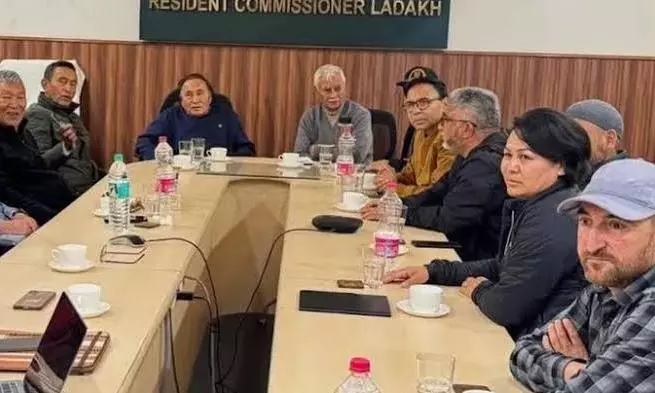
A report published by The Tribune on October 26, citing sources in the Ladakh administration, said officials were in contact with the protesters and that efforts were being made to resolve the issue. The report also said a meeting between the women protesters and the administration had been scheduled for the end of October.
That reported engagement is a potentially important step, but contact alone does not establish that an agreement has been reached or that the protesters’ demands will be accepted.
The central issue for the proposed discussions will be whether the administration is willing to consider specific concerns about the new licences and whether the women’s organisations believe their representations have received a substantive response.
The protesters are demanding closure of the outlets, while a broader review could involve questions about the number and location of licences, restrictions near sensitive sites, enforcement and the consultation process. Whether such measures would satisfy the demonstrators remains unclear.
A productive dialogue would require both sides to set out their positions clearly. The administration would need to explain the policy and its legal basis, while protesters would need an opportunity to present their concerns and discuss possible safeguards or policy changes.
The outcome will matter not only for the immediate agitation but also for how future disputes over social policy are handled in the Union Territory.
Development, Tourism and the Preservation of Local Identity
Ladakh’s tourism economy has grown around its landscapes, cultural heritage, monasteries, festivals and distinctive community life. Decisions affecting the region’s social environment are therefore often debated in the context of how economic development should be balanced with local priorities.
Tourism and hospitality businesses operate within a regulatory environment that includes licensing requirements and rules governing different commercial activities. The expansion of bars or alcohol sales in accommodation establishments has consequently become part of a wider debate about the kind of tourism economy Ladakh wants to develop.
Supporters of the protest argue that economic activity should not come at the expense of family welfare, traditional values or community preferences. The administration, meanwhile, must explain the objectives of its regulatory approach and demonstrate that the rules are being applied consistently.
The issue is not necessarily a choice between economic development and cultural preservation. A region can seek investment and tourism growth while establishing clear rules for commercial activity, protecting sensitive locations and consulting residents about policies that affect community life.
The challenge is to create a framework that takes economic interests seriously without treating social concerns as an afterthought.
What Could Resolve the Stand-Off?
The immediate priority is a credible dialogue between the administration and the organisations leading the protest. Several steps could help move the dispute from competing statements towards a practical resolution.
1. Publish clear information on licences. The administration could explain the number and categories of licences issued, the criteria used, the relevant conditions and the restrictions governing outlet locations.
2. Hear the affected communities. Women’s organisations, village representatives, religious bodies and other local stakeholders should have an opportunity to present specific concerns and receive clear responses.
3. Review sensitive locations and enforcement. Where objections relate to proximity to schools, religious sites or residential areas, the administration could clarify the applicable rules and review whether individual licences comply with them.
4. Assess public-health safeguards. Any policy permitting alcohol sales should be accompanied by effective enforcement, prevention efforts and access to support for people affected by harmful consumption.
5. Explain the scope for policy changes. If the administration cannot agree to a complete ban, it should explain its reasons and clarify whether other measures, including restrictions or a review of licensing decisions, are available.
These steps would not guarantee agreement. The protesters’ demand for a broader prohibition may remain incompatible with the administration’s preferred policy. But a transparent process would make the disagreement easier to understand and could identify areas where practical changes are possible.
Conclusion: A Liquor Policy Dispute Has Become a Test of Public Consultation
The women’s protest in Leh and Sonam Wangchuk’s criticism have brought Ladakh’s liquor policy into a wider debate about public health, cultural identity and the role of local communities in decision-making.
The demonstrators have expressed serious concerns about the possible effects of expanded alcohol availability on families, young people and community life. Their sustained sit-in, including overnight participation in freezing conditions, has kept pressure on the administration to explain its decisions and engage meaningfully with local organisations.
The administration’s reported contact with protesters and the proposed meeting offer an opportunity to move beyond political exchanges. Whether that opportunity produces progress will depend on the seriousness of the discussions, the evidence presented and the willingness of both sides to consider possible ways forward.
Wangchuk’s “alcohol cannons” remark has sharpened the political dispute, but the resolution will depend on more than rhetoric. The administration must explain its licensing policy, the protesters must be heard, and claims about social harm should be evaluated responsibly.
For Ladakh, the larger question is how to balance regulation, economic activity and community priorities in a region with a distinctive cultural identity. The outcome of the current agitation may become an important test of whether public consultation can meaningfully shape decisions that residents believe will affect their collective future.